Alan Turing was born in London, worked in London, and is now commemorated in London by a small blue ceramic disc on the front of a stuccoed Maida Vale building that used to be a nursing home. His father had taken his mother out to the country for the birth, then back to the small Warrington Crescent address that served as her London base while the family moved between India and England. The English Heritage plaque went up in 1998, two years before his fiftieth death anniversary and decades before the official British apology, and it is the single most direct piece of London commemoration for the man who broke the Enigma cipher and laid out the mathematical foundations of the modern computer.
This guide is the longer version of where to find Turing in London. The Warrington Crescent birthplace and what is there now. The Teddington workshop where he sketched the ACE in 1945. The Russell Square address tied to his National Physical Laboratory years. The pavement plaques and street names that have accumulated since the 2009 government apology and the 2013 royal pardon. And how the surrounding cluster of London plaques (Ada Lovelace at St James's Square, Charles Babbage at Dorset Street, Tommy Flowers at Mafeking Avenue) sets Turing's marker in the right context. If you want to plot every plaque against the streets they sit on, the Legacy app maps all 1,625 plaques in London and turns a Turing afternoon into a connected walk rather than a single stop.
The Warrington Crescent Birthplace
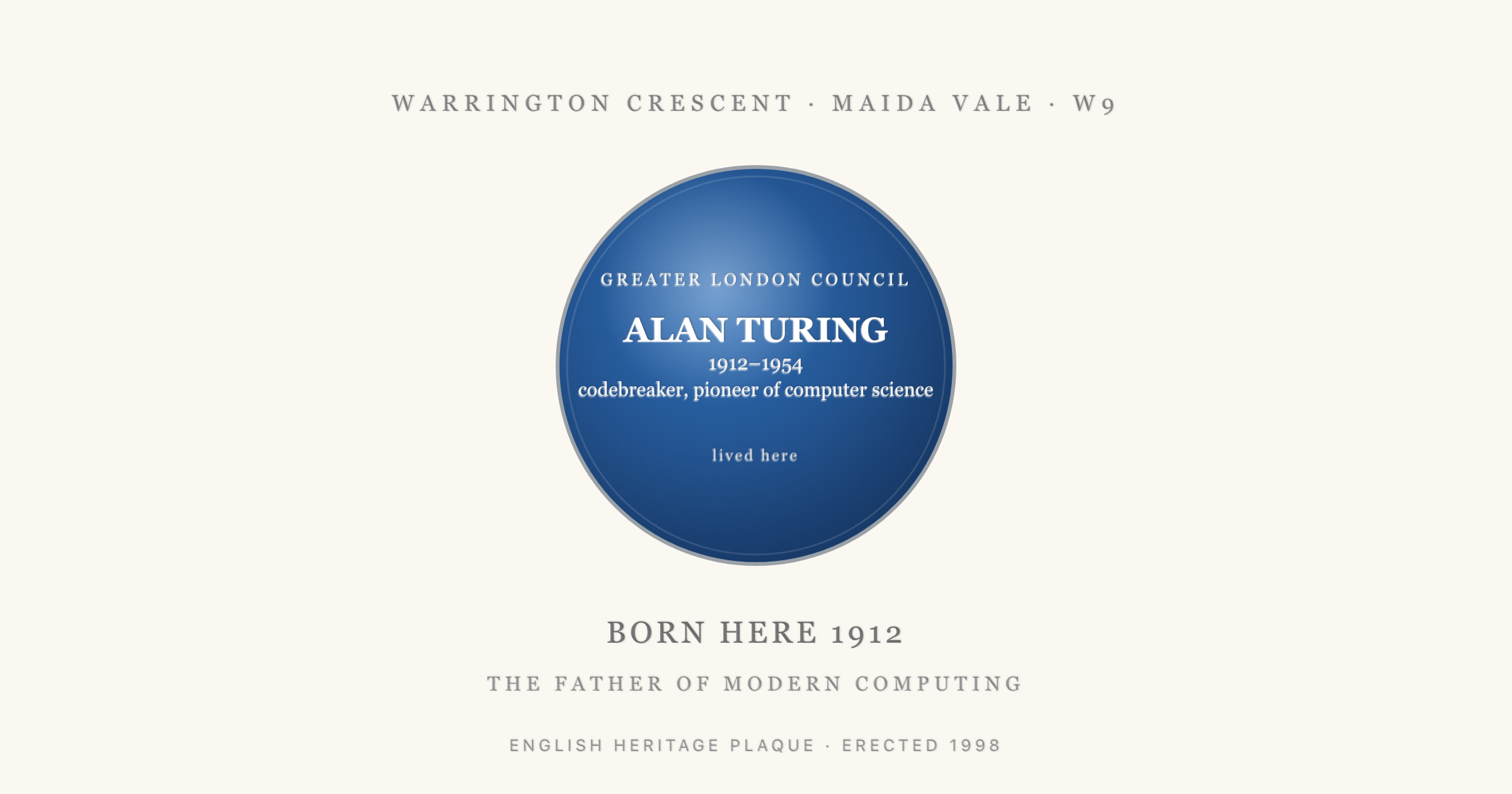
The address is 2 Warrington Crescent, W9 1ER. The building today is The Colonnade Hotel, a four-star Victorian townhouse hotel on a curving residential street in Maida Vale, two minutes' walk from Warwick Avenue tube station on the Bakerloo line. The English Heritage blue plaque is set into the ground-floor frontage, between the porch columns and the basement steps, where it can be read from the pavement without entering the building.
The inscription is short. ALAN TURING / 1912-1954 / Codebreaker and / Pioneer of Computer Science / was born here. The plaque was installed in 1998 by English Heritage, the main London plaque-issuing body, after a successful nomination by the British Computer Society. It was the first English Heritage plaque to use the phrase "codebreaker", which had been declassified slowly across the 1970s and 1980s as the Bletchley Park work emerged into the public record.
The building was a nursing home in 1912 called Warrington Lodge. It was where Sara Turing came to give birth on 23 June, having returned from India for the delivery while her husband Julius continued his work in the Indian Civil Service. The Turings did not live in Maida Vale long-term. Alan and his older brother John spent much of their early childhood with foster families in Hastings while their parents alternated between England and India. Warrington Crescent is the birthplace, not the family home; the building's status is more architectural fact than emotional anchor.
The street itself is worth seeing in its own right. Warrington Crescent is a long curving terrace of mid-Victorian stuccoed houses, built in the 1850s, with a strip of communal garden running down the middle. It sits in the area sometimes called Little Venice for its proximity to the Regent's Canal and the Grand Union Canal junction, a quarter mile north. The Colonnade frontage with the plaque on it has been preserved more or less intact, although the use of the building has shifted from nursing home to private flats to its current hotel function.
How to Visit the Plaque
The plaque is on a public street and visible at all hours. The hotel does not gate access to the plaque itself. The pavement is wide enough to photograph the plaque from a respectful distance without obstructing entry to the hotel.
Practical notes. Warwick Avenue station (Bakerloo line) is the closest tube. From the station, exit via the eastern entrance, walk south along Warwick Avenue for two minutes, then turn right onto Warrington Crescent. The plaque is on the building roughly 60 metres along on the left, between the second and third columned porches. The hotel has a small cafe that is open to non-residents and is one of the few places in the area to sit and read about the man whose plaque you have just photographed.
Pair the visit with the Warwick Avenue cluster. The same Warwick Avenue station was used by Browning when he visited Robert Browning's home at 19 Warwick Crescent (the parallel street), and the Little Venice canal area has a separate cluster of literary plaques: Browning, Edward Lear, and the artist David Cox. For a 90-minute Maida Vale loop, the Turing plaque is the easternmost stop.
Turing's Other London Addresses
The Maida Vale plaque is the major commemoration but not the only Turing address with a London tie. Three other locations carry pieces of the working life that produced the work he is remembered for.
Russell Square and the National Physical Laboratory Years
Between 1945 and 1948, Turing worked at the National Physical Laboratory in Teddington, technically just outside Greater London but functionally part of London for those years. He commuted from various Bloomsbury and Fitzrovia addresses. The most documented is a flat at 5 Northumberland Place, W2 (now demolished), and a longer-term address at 1 Mall Approach in Hampton Hill where he lived for parts of 1947.
His office at the NPL is in the Bushy House complex, a former royal residence that NPL has occupied since 1900. The building is not open to the general public but the Bushy Park grounds around it are. The ACE pilot machine that descended from Turing's 1945 design paper now sits in the Science Museum in South Kensington, on permanent display in the Information Age gallery. That is the closest publicly-accessible Turing artefact in central London.
For the engineering side of Turing's London years, the Science Museum at Exhibition Road is the necessary stop. The Pilot ACE went into operation in 1950, two years after Turing left NPL frustrated by the slow institutional pace. It is a working artefact of the design Turing wrote in 1945, a decade before the more famous Manchester machines.
King's College, Cambridge and the London Connection
Turing's intellectual life was based at King's College, Cambridge, from 1931 onward, but he frequently came to London for the Royal Society, the Mathematical Society meetings at Burlington House on Piccadilly, and the wartime planning meetings at the GC&CS headquarters at 54 Broadway in Westminster (the building still stands; it does not have a Turing plaque but does have a plaque commemorating the Government Communications Headquarters work, the cover designation for the Bletchley operation).
54 Broadway, opposite St James's Park station, is the closest central London address to the Bletchley Park work. It was the GC&CS HQ before the Bletchley dispersal in 1939 and remained the London administrative office through the war. Turing came down from Bletchley on the train regularly for meetings there, and the address is part of the geography of his work even though it is not formally commemorated for him.
The Hampton Workshop
After the NPL years, Turing moved to Manchester for his final period of work, but his Hampton Hill flat had a workshop where he prototyped some of the components for what became the ACE design. Hampton Hill is now part of the London Borough of Richmond upon Thames, and the address is at 1 Mall Approach, a small cul-de-sac off St James's Road. There is no plaque there. The building still stands.
The Hampton workshop is a less-visited stop on the Turing geography because it sits at the edge of London, beyond zone 5 on the rail network, and most central-London Turing tours stop at the Maida Vale plaque. For a completionist, the address is on the Hampton train line out of Waterloo, with a fifteen-minute journey from central London.
The London Computing Cluster Around Turing
The Warrington Crescent plaque sits in a wider cluster of London computing-history plaques. Three other major figures have plaques within a short walking or transport hop of Turing's, and seeing them together gives the historical context that the single plaque cannot.
Charles Babbage at Dorset Street
Charles Babbage, the Victorian polymath who designed the Analytical Engine in the 1830s and who is the most direct intellectual ancestor of Turing's universal machine concept, has a brown plaque at 1 Dorset Street, W1, just off Marylebone High Street. Babbage lived there from 1828 to his death in 1871. The Difference Engine and the Analytical Engine were both designed in that house. The plaque is brown rather than blue because it was installed by the Royal Society of Arts under an earlier scheme, before the present blue-plaque convention solidified.
For a Turing visitor, the Babbage stop sets the long arc. Turing's 1936 paper on computable numbers built directly on the conceptual work Babbage had laid out a hundred years earlier, and the geographic distance between the two plaques (Maida Vale to Marylebone, two miles) understates the intellectual distance (a hundred years and a discipline).
Ada Lovelace at St James's Square
Ada Lovelace, Babbage's collaborator and the author of the famous Note G that contains the first published program written for a computer, has a blue plaque at 12 St James's Square, SW1, on the building she lived in during her later years. The plaque is on a Georgian townhouse on the south side of the square, currently part of an office complex.
Lovelace's relationship to Turing is the second necessary piece of the cluster. Turing's 1950 paper "Computing Machinery and Intelligence", which proposed the Imitation Game (now called the Turing Test), spends part of its argument addressing what Turing called "Lady Lovelace's Objection": her contention in Note G that computing machines could only do what they were programmed to do and not originate anything. Turing's response is one of the foundational texts of artificial intelligence research. Walking from Lovelace's plaque to Turing's traces both halves of that hundred-year argument across two miles of central London.
Tommy Flowers at Mafeking Avenue
Tommy Flowers, the engineer who built the Colossus machines that automated parts of the Bletchley codebreaking work, has a plaque at 160 Mafeking Avenue in East Ham, E6. Flowers was the GPO research engineer at Dollis Hill who took Turing and Max Newman's mathematical specifications and turned them into the world's first electronic programmable computer.
Flowers and Turing did not always agree on direction. Flowers had to push hard against institutional scepticism to get Colossus built; Turing was sometimes one of the sceptics, although the disagreements were technical rather than personal. The two plaques together commemorate the mathematical and engineering halves of the same enterprise. The Mafeking Avenue plaque is the easternmost stop on a London computing-history walk and worth pairing with the Maida Vale plaque on the same day if you have the time.
What the Plaque Does Not Say
The Warrington Crescent inscription is short and necessarily clean. There are three pieces of the Turing story that the plaque does not address but that visitors usually want to know about.
The Conviction and the Royal Pardon
In 1952 Turing was prosecuted under Section 11 of the Criminal Law Amendment Act 1885 for "gross indecency" after acknowledging a relationship with another man. The conviction led to chemical castration as an alternative to imprisonment, the loss of his security clearance, and indirect ostracism from the post-war intelligence community he had served. He died in 1954 at his Manchester home; the inquest ruled suicide, although a 2012 reassessment of the evidence by historian Jack Copeland argued that accidental cyanide inhalation from a galvanic-cell experiment was at least equally likely.
The British government issued a formal apology in 2009, after a public petition led by John Graham-Cumming. The royal pardon was granted in 2013. The "Turing Law" of 2017 extended the pardon to other men convicted under the same statute. None of this is on the plaque, which was installed in 1998. The plaque commemorates the work; the public memory has expanded around it since.
The Bletchley Years
Bletchley Park itself is in Buckinghamshire, an hour by train from Euston, and is now a museum in its own right with extensive Turing-specific exhibits. For a visitor to the Maida Vale plaque interested in the Bletchley story, the Buckinghamshire trip is the necessary follow-up. The BBC's 2014 film "The Imitation Game" and the books it drew on (Andrew Hodges's 1983 "Alan Turing: The Enigma" remains the standard biography) cover the wartime period in depth.
The London plaque cannot carry the Bletchley narrative because Bletchley is geographically and institutionally separate. The plaque is the birthplace marker, not the working-life marker. The combination of the Warrington Crescent visit and the Bletchley day trip is the full Turing tour.
The Computer Science Legacy
The phrase "Pioneer of Computer Science" on the plaque does not unpack what that means. The Turing machine concept (1936), the universal computer formulation (1936-37), the ACE design paper (1945), the test for machine intelligence (1950), and the morphogenesis paper (1952) are five separate foundational contributions, and the field of theoretical computer science largely traces back to the first two of them.
For the technical follow-up, the Science Museum's Information Age gallery in South Kensington has the Pilot ACE machine on display along with explanatory material. The British Library has digitised copies of the original 1936 paper accessible through their main reading room. The Bletchley Park museum has a recreated bombe machine running daily demonstrations.
Three Plaque Walks That Include Turing
Three walking routes connect the Maida Vale Turing plaque to other parts of his story and the surrounding London commemorations.
Walk 1: The Maida Vale Two-Plaque Loop (45 minutes)
Start at Warwick Avenue station. Walk south to the Turing plaque at 2 Warrington Crescent. Continue along Warrington Crescent to its junction with Clifton Gardens. Turn left, then left again onto Warwick Avenue and walk north to the Browning plaque at 19 Warwick Crescent (the literary anchor of Little Venice). Continue along the canal towpath to the cafe at the Browning's Pool junction. Total: 45 minutes including reading time at each plaque, ending at Warwick Avenue station.
Walk 2: The Turing-Babbage-Lovelace Computing Walk (3 hours)
Start at Warwick Avenue, see the Turing plaque. Bus 6 or tube to Marble Arch, then walk to Marylebone for the Babbage plaque at Dorset Street. Walk south through Mayfair to St James's Square for the Lovelace plaque at number 12. Total: about 3 hours including travel and reading. The walk is the shortest route through the three London plaques that mark the conceptual and institutional roots of computer science.
Walk 3: The Turing-Bletchley Day Trip
Start at Warwick Avenue for the Maida Vale plaque. Tube or bus to Euston for the Bletchley Park train (45 minutes). Spend three to four hours at the Bletchley museum. Return train, optional dinner near Euston. Total: a full day, recommended for a first deep visit because the Bletchley work is the biggest single piece of the Turing story and London alone cannot tell it.
What to Bring Home
The Turing plaque is small, plain, and intentionally undramatic. Most visitors photograph it, read the few lines, and stand for a moment thinking about how compressed the marker is for the size of the contribution. The point of seeing it in London is not the plaque on its own. It is the connection between this anonymous Maida Vale frontage and the rest of the London geography that produced the work the plaque names: the King's College Mathematical Society, the Royal Society at Burlington House, the GC&CS office at 54 Broadway, the Science Museum's surviving Pilot ACE.
If you want the connected version of the visit, the Legacy app plots the Turing plaque against the surrounding cluster of London computing and mathematical plaques and turns the day into a structured walk. The complete guide to blue plaques in London covers the wider scheme, and the alternative walking tour suggests three other plaque-led walks across the city. For a different scientific-genius angle, the Charles Dickens Museum guide covers the same Bloomsbury district where Turing's NPL-years flat sat.
Turing's birthplace on Warrington Crescent is the smallest, quietest stop on most London science walks. It is also the one whose subject the city took longest to publicly forgive, and the one whose plaque carries the most weight per word.