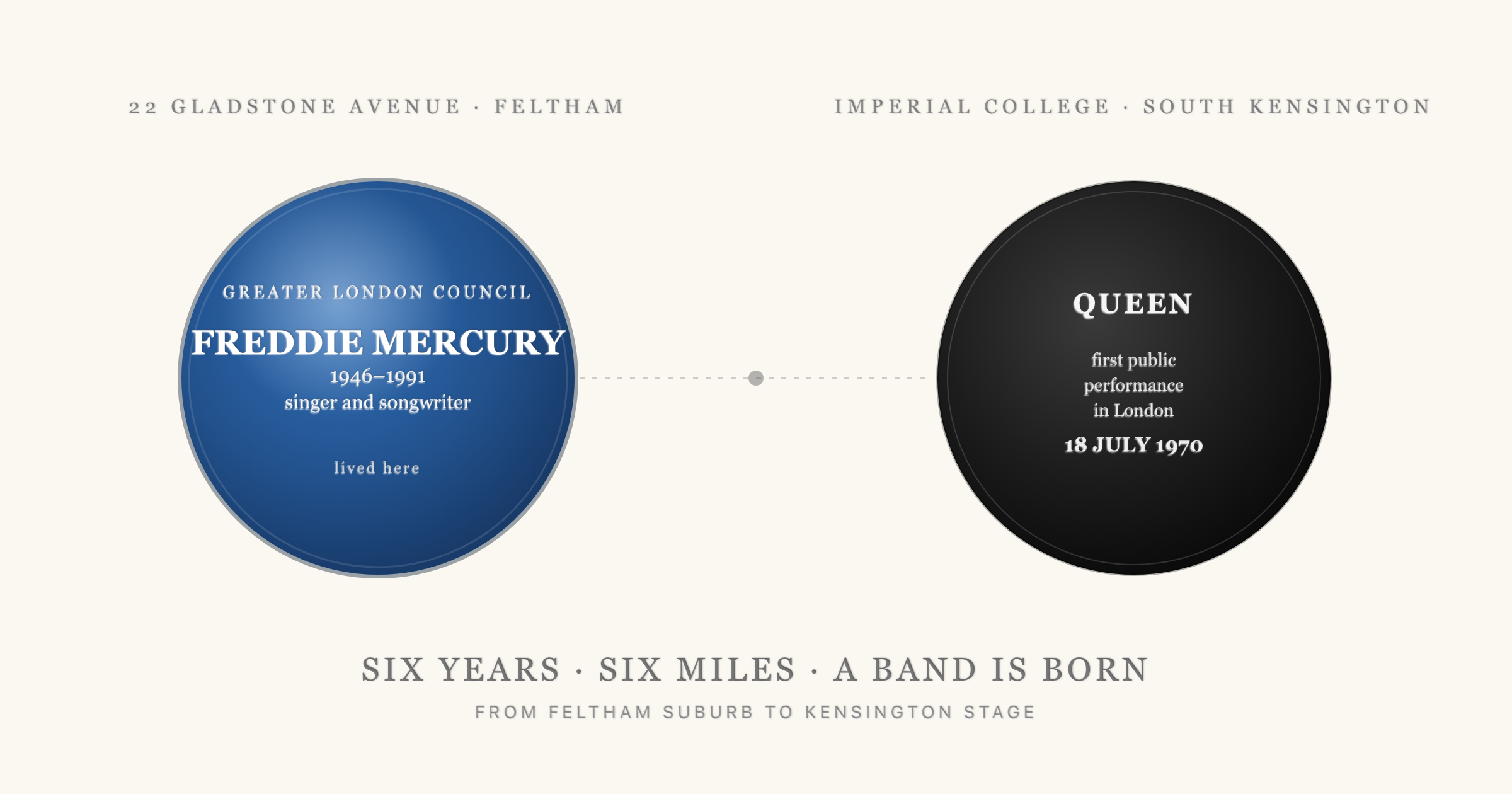
The Freddie Mercury blue plaque is in the least rock-and-roll place in London: a quiet residential street in Feltham, west of Heathrow, on the pebbledash wall of a 1930s semi-detached house. 22 Gladstone Avenue is where Farrokh "Freddie" Bulsara lived with his parents and sister from 1964, the year the family arrived in Britain from Zanzibar, until he left home in 1969 to commit full-time to the band that would become Queen. The plaque was unveiled here in September 2016, twenty-five years after his death, and it is the only English Heritage blue plaque anywhere in London to Freddie Mercury.
This guide covers the plaque itself, what the house and the street looked like in the 1960s, the milestones of Freddie's London life that ran outward from 22 Gladstone Avenue, Queen's first ever public concert in London (itself now marked by a plaque), and a walking route through Kensington for visitors who want to continue the pilgrimage to Garden Lodge, the home Freddie bought in 1980 and where he died in 1991.
The Blue Plaque at 22 Gladstone Avenue, Feltham
The plaque is a standard English Heritage ceramic blue roundel, installed on the front of the house at first-floor height. The inscription reads:
Freddie Mercury (Fred Bulsara) 1946-1991 singer and songwriter lived here
Two things about that wording are worth noting. First, the parenthetical "Fred Bulsara" is rare on English Heritage plaques, which usually record one name. The committee chose to include both because Farrokh Bulsara became Fred at school and only became Freddie Mercury years later, and the Gladstone Avenue house is firmly the Fred Bulsara chapter of the biography. Second, "singer and songwriter" is deliberately modest. English Heritage plaques are written in a neutral, almost dry register, so a man who fronted one of the biggest rock bands in history gets the same descriptor as a folk musician from Finchley.
The plaque was unveiled on 1 September 2016 in a ceremony attended by Brian May and by Freddie's sister, Kashmira Cooke. It is, by convention, installed only on properties where the commemorated figure actually lived, and English Heritage's criteria require the figure to have been dead for at least 20 years (or to have passed their 100th birthday) before they are eligible, which is why the plaque could not be installed earlier.
The House and the Family, 1964 to 1969
The Bulsara family arrived at 22 Gladstone Avenue in 1964, having left Zanzibar during the revolution that had displaced the island's Parsi Zoroastrian community. Freddie was seventeen. He had already spent most of his school years at St Peter's in Panchgani, India, a boarding school where he had learned piano, started his first band (the Hectics, a skiffle-influenced school group), and been given the name "Fred" by classmates who found "Farrokh" unwieldy.
Gladstone Avenue in the 1960s was a solidly middle-class street of interwar semis, two bus rides from central London, a few streets away from the grounds of what would become Heathrow's southern runway. The house has a small front garden, a long back garden, and the kind of quiet respectability that made it the wrong backdrop for the man Freddie was becoming. He enrolled at Isleworth Polytechnic to complete his A-levels, then at Ealing Art College for a graphic-design diploma, both reachable from Feltham by bus.
The key biographical milestones that happened while Freddie was living at Gladstone Avenue:
- 1966: enrolled at Ealing Art College, where he met and befriended a classmate called Tim Staffell, who played in a band called Smile with a guitar-playing dentistry student named Brian May and a drummer called Roger Taylor.
- 1969: graduated from Ealing with a diploma in graphic design. The same year he left 22 Gladstone Avenue and moved into a flat in Kensington with Staffell and the Smile band, putting him around the corner from Imperial College, where Smile rehearsed.
- April 1970: Tim Staffell left Smile to join Humpy Bong. Freddie, Brian May, and Roger Taylor formed a new band. Freddie insisted on a one-word, royal name. Queen.
The last item is the point where the story leaves Gladstone Avenue and becomes the Queen story. But every bit of preparation, the classically trained piano, the theatrical instinct, the graphic-design eye for stage iconography, was formed behind that pebbledash front wall in Feltham.
The Queen Black Plaque at Imperial College
The second piece of Freddie's London plaque trail is not a blue plaque at all. It is a black plaque, installed by the Performing Right Society in March 2013, at Imperial College London on Prince Consort Road. The inscription reads:
QUEEN first public performance in London here 18 July 1970
The date is three months after Queen formed. The venue was Imperial College's Great Hall, where Brian May was a student and where Smile had been rehearsing. The bill was a support slot. Most accounts put the audience at well under a hundred. By any reasonable measure, the gig was unremarkable. Freddie was still living in a flat on Ferry Road with the band members, still sometimes working a market stall in Kensington Market to make rent, still not using the surname Mercury on stage.
The gig becomes historically significant only in retrospect, which is what a plaque is for. Imperial College in South Kensington is a seven-minute walk from the future Garden Lodge, and four miles from 22 Gladstone Avenue as the crow flies, though the journey by bus and tube is closer to an hour even today. Feltham to the Great Hall is the geographic arc the plaque trail traces.
Garden Lodge and the Kensington Years
There is no English Heritage blue plaque at Garden Lodge, 1 Logan Place, Kensington. There cannot be, under the rules: the current resident is Mary Austin, Freddie's former partner and life-long friend, to whom he willed the house. English Heritage does not install plaques on private residences while they are still occupied by people directly connected to the person being commemorated, so a blue plaque at Garden Lodge will not be possible in the foreseeable future.
Logan Place is nonetheless a place of pilgrimage. The high garden wall that fronts the property is covered, end to end, in handwritten messages, lyrics, hearts, and initials from fans who have been leaving them there since 1991. The wall is unofficial, repainted periodically by the estate, and immediately re-graffitied. Mary Austin has not asked for it to stop. It is arguably the most powerful informal memorial in London, and visiting it is the natural second leg of any Freddie Mercury blue plaque pilgrimage, even though it is not itself a plaque.
For a broader sense of how English Heritage blue plaques work (who qualifies, how they are chosen, where the blue gets its colour), our complete guide to London's blue plaques covers the history and the criteria in detail.
A Walking Route for Visitors
Most visitors pair the Feltham plaque with a South Kensington walking route, because the Feltham house is a 45-minute train ride from central London and the Kensington sites are concentrated. Here is a practical half-day itinerary, assuming you start in central London.
Leg 1: Feltham
Take the South Western Railway service from London Waterloo to Feltham. The journey is around 30 minutes. 22 Gladstone Avenue is a ten-minute walk from Feltham station, heading south on Bedfont Lane and turning right onto Gladstone Avenue.
Give yourself twenty minutes at the plaque. The house is a private residence, so stand on the pavement opposite, not in the driveway. Photograph the plaque from a respectful distance. The street has no cafe or facilities, so plan to return to the station afterwards.
Leg 2: South Kensington
From Feltham, take the train back to Vauxhall, then the Victoria Line to Green Park, then the Piccadilly Line to South Kensington. Alternatively, change at Clapham Junction for a more scenic loop. Either way, budget an hour of travel.
South Kensington station puts you within a short walk of all three Queen-relevant sites:
- Imperial College Great Hall, Prince Consort Road (eight-minute walk from the station). The Queen black plaque is on the exterior wall of the Great Hall.
- Garden Lodge, 1 Logan Place (fifteen-minute walk from the station, through Kensington proper). The fan-message wall is on the Logan Place side of the corner property, accessible from the public pavement. Again, the house is private. Respect the wall but do not knock on the door.
- Kensington Market (former location), 49-53 Kensington High Street (ten minutes from the station). The market where Freddie and Roger Taylor ran a clothing stall called Kensington Antique Market in 1970 is long gone, replaced by Boots, but the street is still atmospheric and worth walking past for the completist.
The three sites together make a gentle two-hour loop through Kensington, ending naturally at a pub on Earl's Court Road or back at South Kensington station for the tube home.
Other Queen-Adjacent Plaques Worth Knowing
For the dedicated fan, London has a handful of other plaques that touch on the Queen story:
- Brian May's childhood home in Feltham, a short distance from Gladstone Avenue, has no official plaque, but local-history groups occasionally run tours that include the exterior. Worth mentioning only because Brian and Freddie were effectively neighbours in the West London suburbs before they ever met at Ealing.
- Roger Taylor's childhood home in Truro, Cornwall, is outside London and outside the scope of this guide.
- Wembley Stadium, the site of the Live Aid performance on 13 July 1985, has no plaque to Freddie specifically, but there is a statue of him at the Montreux Casino on Lake Geneva (where much of News of the World and The Miracle were recorded), for readers who find themselves in Switzerland rather than London.
For a wider walking route covering multiple musician plaques, including the one to Jimi Hendrix, see our article on the Handel Hendrix House on Brook Street, which sits at the centre of a compact cluster of Mayfair music-history plaques.
Visiting the Freddie Mercury Blue Plaque
The plaque at 22 Gladstone Avenue is outdoors, on a public street, free to visit at any time. It is accessible by train from central London (Feltham station, South Western Railway from Waterloo) or by car via the M4 and the A315. There is no fee, no queue, no gatekeeper.
The house itself is privately owned and has changed hands since the plaque was installed. Do not enter the driveway, do not photograph through windows, do not ring the bell. The residents have been generous in allowing the plaque to remain a public landmark, and that generosity is worth respecting.
If you want to build a longer day around London's blue plaques, the free London Blue Plaques app maps all 1,625+ plaques across the city, including Freddie's and Queen's. It is particularly useful for plaque walks in unfamiliar neighbourhoods, because the app shows you which plaques are within a short walk of wherever you happen to be standing.
The Feltham plaque is not the most photogenic Queen landmark in the world. It is a small blue roundel on a suburban semi. But it is the one place in London where the biographical fact of Farrokh Bulsara becoming Freddie Mercury was recorded officially, in a municipal register of significance, and that makes it worth the train ride.