Historical pubs in London are the only buildings in the city where you can still drink in a room that has continuously poured beer since before the English Civil War. The twelve below sit on a chronological line from 1546 (the year of England's first licensed alehouse mention near Smithfield) to 1939 (the late Victorian-Edwardian boom that froze London's pub geography in place before the Blitz scattered it). Roughly half of them have a blue plaque on a wall within thirty seconds' walk, marking the writer, painter, MP, or radical who used the pub as a second living room. The other half should have plaques and do not, which is its own kind of plaque.
This guide walks the twelve in order of founding, with the address, the writer or political tenant who haunted the back room, and the blue plaque (if any) you should detour to on the way out. It is not a list of "best pubs" or "most touristy"; it is a route through London's last continuously occupied four-and-a-half centuries.
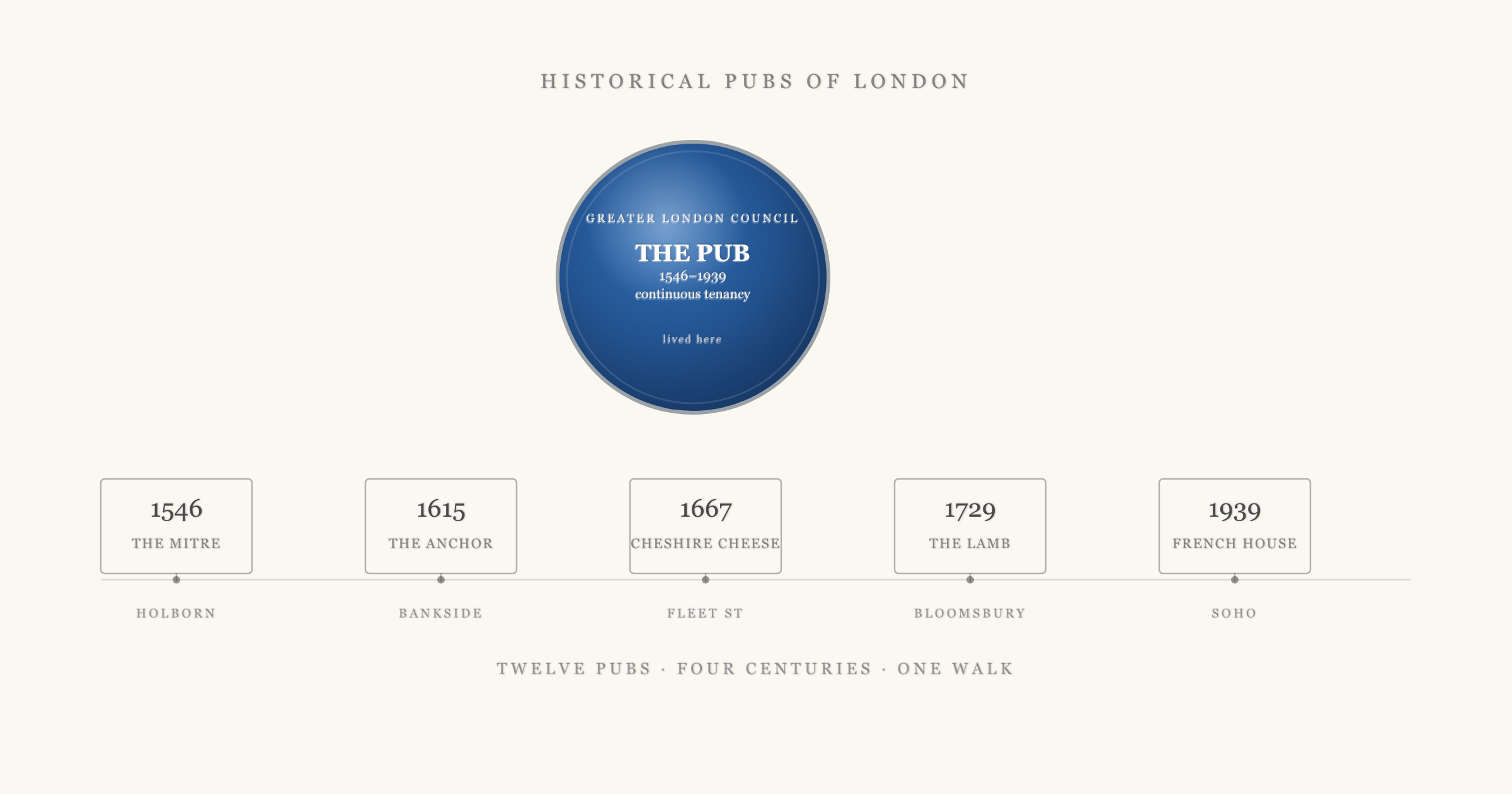
How To Read This Guide
Every entry follows the same six-line spine:
- Pub name and address. With the postcode so you can map it.
- Founded. First documented date of trading on the site (or the founding year if the building is original to the trade).
- The story. What happened in the building beyond the obvious.
- The famous regular. The writer or political figure most associated with the pub.
- The plaque next door. The English Heritage or City of London plaque within walking distance.
- Why visit. A one-line reason to bother.
You can drink at all twelve in a single weekend if you pace yourself; they are scattered across central London with the densest cluster in Holborn, Bloomsbury, and the City. A conservative estimate is two pubs per afternoon for six afternoons, which is the way most pub-history walking-tour operators run the route.
1. The Mitre, Ely Place (1546)
Address: 1 Ely Court, Holborn EC1N 6SJ Founded: 1546 (current building 1772, on the same plot) The story: The Mitre sits down a near-invisible alley off Ely Place, and the alley sits inside what was technically not London until 1842. Ely Place was the London estate of the Bishops of Ely, a quasi-foreign jurisdiction governed by the Cambridgeshire diocese, where London law did not run. Elizabeth I granted the Mitre its first licence to keep her court entertained when she visited the Bishop's London residence. Two centuries later, when the Bishops sold the estate, Ely Place still kept its private-jurisdiction quirk, and the pub kept its mediaeval cherry tree, around which Elizabeth supposedly danced. The famous regular: Charles Dickens, who used the Mitre as the model for the inn in David Copperfield. Samuel Johnson reputedly drank here in the 1750s. The plaque next door: A City of London plaque at 14 Ely Place commemorating the long-vanished Bishop's palace. Walk through the pub's back garden and the cherry-tree fragment is signposted. Why visit: It is the closest thing London has to drinking inside a piece of Cambridgeshire.
2. Ye Olde Cheshire Cheese, Fleet Street (1667)
Address: 145 Fleet Street EC4A 2BU Founded: Rebuilt 1667 after the Great Fire on the site of a 13th-century inn The story: The Cheshire Cheese is the most famous "old pub" in London for a reason. It rebuilt the year after the fire, kept its sawdust floors and warren of low-ceilinged back rooms, and became the unofficial canteen of the Fleet Street press through the entire era when Fleet Street meant national journalism. The dim, smoke-blackened panelling of the snug is original 17th-century timber. The pub is so structurally non-modernised that the ground-floor bar requires you to duck through three different doorways. The famous regular: Samuel Johnson and James Boswell. Charles Dickens. W. B. Yeats. G. K. Chesterton. Mark Twain. Theodore Roosevelt. The plaque on the wall lists the literary regulars. Most of London's 18th and 19th century print-trade figures drank here at some point. The plaque next door: Samuel Johnson's house at 17 Gough Square, two minutes' walk through the alleys, with its English Heritage blue plaque. Why visit: If you only walk one of the twelve, walk this one. It is the closest physical connection most visitors get to 18th-century London literary life.
3. The Lamb and Flag, Covent Garden (1772 in current form, site 1623)
Address: 33 Rose Street, Covent Garden WC2E 9EB Founded: Site licensed since 1623; pub building 1772 The story: Originally called the Bucket of Blood for the bare-knuckle prize fights held in the upstairs room. The current Lamb and Flag name dates to the early 19th century. Rose Street was a rough alley behind Covent Garden market, and the pub's reputation was for the kind of drinkers who would not be welcome at Drury Lane. The poet John Dryden was attacked in the alley outside in 1679 by hired men of the Earl of Rochester; the pub still flags the incident with a plaque inside. The famous regular: John Dryden (the assault aside, he drank here before it). Charles Dickens. Bohemian artists from the 1860s through the 1920s. The plaque next door: The Royal Opera House blue plaque on Bow Street, three minutes' walk. Multiple Covent Garden plaques within five minutes. Why visit: The upstairs room (now a quiet dining space) was the prize-fight venue; the smell of two centuries of spilled beer is still in the floorboards.
4. The Spaniards Inn, Hampstead (1585, current form 1750)
Address: Spaniards Road, Hampstead NW3 7JJ Founded: 1585 as a tollhouse-pub on the road north out of London; current form 1750 The story: The Spaniards is far enough out of central London (on the edge of Hampstead Heath) that most pub-history lists skip it. They should not. The pub's tollhouse origins, when the road north from London was a brigands' route, made it a known stopover for highwaymen. Dick Turpin's father was reputedly the licensee. John Keats drank here while writing "Ode to a Nightingale" in the spring of 1819 (the nightingale heard from the pub garden may have been the bird). Dickens used the pub as the meeting place in The Pickwick Papers. The famous regular: John Keats. Charles Dickens. Bram Stoker (who set part of Dracula in the surrounding Heath). The plaque next door: John Keats's house at Wentworth Place, twenty minutes' walk south through the Heath, with its English Heritage plaque. Why visit: It is the only pub on this list where you can drink in a building with an active road still running so close to the door that the original toll-collection slot in the wall is visible.
5. The Prospect of Whitby, Wapping (1520, current form 18th c.)
Address: 57 Wapping Wall, Wapping E1W 3SH Founded: Reputedly 1520, making it one of the oldest documented riverside pubs in London The story: Wapping was London's smugglers' and dockers' end of the river for three centuries. The Prospect of Whitby (originally The Pelican, renamed after a Whitby coal collier moored regularly outside) was the pub of the 18th-century docks, where Judge Jeffreys reportedly watched executions on the gibbet outside. The current pub has the gibbet replica on the riverside terrace and a flagstone floor that may be the oldest in any London pub. The famous regular: Charles Dickens, Samuel Pepys, J. M. W. Turner (who sketched the river from the upstairs window), James McNeill Whistler. The plaque next door: The Charles Dickens connection-plaque on Wapping High Street, eight minutes' walk west. Why visit: The river view from the pub's pewter-topped bar is unchanged since Turner's drawings. The gibbet replica is grim and historically accurate.
6. The George Inn, Borough High Street (Pre-1543, current form 1677)
Address: 75-77 Borough High Street, Southwark SE1 1NH Founded: Pre-1543 coaching inn; current form 1677 (the only galleried Elizabethan-style coaching inn left in London) The story: The George is the last surviving galleried coaching inn in London, owned now by the National Trust. Borough High Street was the road into the City from the south, and the medieval coaching inns lined it for half a mile. The Tabard Inn, where Chaucer's pilgrims started their Canterbury journey, stood next door (a plaque marks the site). Most of the inns were demolished for railway expansion in the 19th century. The George survived, partly because Charles Dickens drank there often enough that conservation pressure built up by the late 1800s. The famous regular: William Shakespeare (almost certainly, as Globe Theatre players based two streets away). Charles Dickens (he name-checks the inn in Little Dorrit). Pepys. The plaque next door: The Tabard Inn marker (where Chaucer's pilgrims gathered) on the same block, plus several Borough plaques within three minutes. Why visit: It is the closest thing in London to a working Shakespeare-era playhouse environment, with the gallery upstairs that Shakespearean theatre derived its architecture from.
7. The French House, Soho (1891, current ownership 1914)
Address: 49 Dean Street, Soho W1D 5BG Founded: Opened 1891; bought by the Berlemont family in 1914 and run as the unofficial London headquarters of the Free French during the Second World War The story: Charles de Gaulle wrote and signed the 18 June 1940 "À tous les Français" rallying speech in the upstairs room of the French House (then called the York Minster). The pub was the Free French London base for the duration of the war. After 1945 it became the Soho writers' and artists' pub of the 1950s and 1960s, with Francis Bacon, Lucian Freud, Dylan Thomas, Brendan Behan, and the post-war literary set drinking through the afternoons. A house rule still bans mobile phones. The famous regular: Francis Bacon. Lucian Freud. Dylan Thomas. Brendan Behan. Charles de Gaulle. The plaque next door: Plaques to Karl Marx (28 Dean Street) and several Soho writers within five minutes' walk. Why visit: It is the only pub on the list with a continuous post-1940 literary history that you can still drink inside today, and the no-phones rule means the room actually sounds like a pub instead of a phone bank.
8. The Coach and Horses, Soho (1847)
Address: 29 Greek Street, Soho W1D 5DH Founded: 1847 in the current form The story: The Coach and Horses was the Private Eye magazine's lunch venue for forty years and the unofficial home of Soho-bohemia journalist Jeffrey Bernard, whose drunkenly missed Spectator column "Jeffrey Bernard Is Unwell" became the title of a Keith Waterhouse play. The pub's landlord Norman Balon ran a forty-year campaign to be the rudest pub-keeper in London. The Friday lunches with Ian Hislop and Richard Ingrams writing copy at the corner table are still local legend. The famous regular: Jeffrey Bernard. Peter Cook. Ian Hislop. Auberon Waugh. The full Private Eye roster from the 1970s onwards. The plaque next door: The Karl Marx plaque at 28 Dean Street, three minutes' walk. Why visit: It is the closest thing in central London to drinking inside a piece of post-war London journalism.
9. The Anchor, Bankside (1615, current form 1775)
Address: 34 Park Street, Bankside SE1 9EF Founded: 1615 on the site of a Roman tavern; current form 1775 after fires and rebuilds The story: The Anchor sits on the south side of the Thames, a hundred yards from the Globe Theatre, on what was Bankside's bear-baiting and theatre district. Samuel Pepys watched the Great Fire of 1666 from the Anchor's upper floor. The site has been a tavern since at least Roman London, and there is archaeological evidence of beer-trade activity dating to the Roman period. Shakespeare drank here while working at the Globe; Johnson drank here while writing his dictionary at the next-door brewery house belonging to his friend Henry Thrale. The famous regular: Samuel Pepys. Samuel Johnson. William Shakespeare (probably). The plaque next door: Multiple Bankside plaques (Globe, Pepys, Johnson) within six minutes. Why visit: The view across the river to St Paul's is unchanged since Pepys watched it burn.
10. The Fitzroy Tavern, Fitzrovia (1883)
Address: 16A Charlotte Street, Fitzrovia W1T 2NA Founded: 1883 in the current building; the area's literary pub since the 1920s The story: The Fitzroy Tavern is the pub that gave Fitzrovia its name. From the 1920s through the 1950s, the front bar was the gathering place for the literary, artistic, and bohemian London that did not fit Bloomsbury or Soho. Augustus John, Dylan Thomas, George Orwell, Quentin Crisp, and Aleister Crowley all drank here at different points. The "Pennies from Heaven" charity (drinkers stuck pennies into the ceiling for charity collection) ran from the 1920s and the practice has been recreated in the current bar. The famous regular: Dylan Thomas. George Orwell. Augustus John. Quentin Crisp. The plaque next door: Multiple Fitzrovia and Bloomsbury plaques within ten minutes. Why visit: The pub gave the neighbourhood its name; the neighbourhood gave 20th-century English literature half its venues.
11. The Lamb, Lamb's Conduit Street (1729, current form 1850)
Address: 94 Lamb's Conduit Street, Bloomsbury WC1N 3LZ Founded: 1729; current Victorian pub building 1850 The story: The Lamb is the last pub in central London with surviving "snob screens", the etched-glass partitions Victorian middle-class drinkers used to obscure themselves from the bar staff (so they could be seen at the bar without being seen by the bar). The screens are original to the 1850 rebuild. Dickens drank here while living at 48 Doughty Street, two minutes' walk away. The pub's customers in the 19th century included the Bloomsbury writers in the early decades of the 20th. The famous regular: Charles Dickens. Bloomsbury Group writers (Virginia Woolf lived a few streets away; she did not drink here often, but several of her circle did). The plaque next door: The Charles Dickens Museum (48 Doughty Street) is two minutes' walk; multiple Bloomsbury plaques within ten minutes. Why visit: The snob screens are the only working set in central London. The Dickens Museum walk is the easiest pairing.
12. The Dog and Duck, Soho (1734, current building 1897)
Address: 18 Bateman Street, Soho W1D 3AJ Founded: 1734; current Victorian-tiled building 1897 The story: The Dog and Duck is a small Soho corner pub with the most preserved Victorian-era tiled interior in central London. The walls and bar-front are floor-to-ceiling glazed tile, original to the 1897 rebuild, with the pub's original Doulton tiling intact. George Orwell drank here regularly while working at the BBC during the Second World War; he reportedly found the small upstairs room ideal for the kind of conversation that did not need to be overheard. The famous regular: George Orwell. John Constable (the painter, who lived nearby). The plaque next door: Multiple Soho plaques within five minutes; the Karl Marx plaque on Dean Street is six minutes' walk. Why visit: The tiled interior is closer to Victorian-pub-as-museum than any other small pub in central London.
A Walking Order
If you want to drink the route in geographical rather than chronological order:
Day 1 (Holborn / Fleet Street): The Mitre → Ye Olde Cheshire Cheese → The Lamb (Lamb's Conduit Street). Detour for the Samuel Johnson House plaque and the Charles Dickens Museum.
Day 2 (Soho / Covent Garden): The Lamb and Flag → The French House → The Coach and Horses → The Dog and Duck → The Fitzroy Tavern. Detour for the Karl Marx plaque on Dean Street and the cluster of Fitzrovia/Bloomsbury plaques north of Oxford Street.
Day 3 (River / South Bank / Wapping): The George Inn → The Anchor → The Spaniards Inn (this last one is a longer trip out to Hampstead) → The Prospect of Whitby. Detour for the Tabard Inn marker, the Globe area plaques, and Keats's House if you make it to Hampstead.
For specific neighbourhood plaque clusters, the Blue Plaques London complete guide lays out the plaque density per area, and the alternative walking tour using the city's blue plaques has four routes that intersect with this pub list at multiple points.
Why the Pubs Outlive the Plaques
Of the twelve pubs above, ten existed before the first English Heritage blue plaque scheme started in 1866. They are older than the commemorative system that now hangs from the buildings around them. That is the unusual thing about historical pubs in London: they are not commemorations, they are continuities. The buildings have not been preserved in the way a museum is preserved. They have been continuously used, badly cleaned, periodically rebuilt within their footprint, and consistently in the trade of pouring beer for the same purpose since before the King James Bible was printed.
That is also why, walking the twelve, you will often find the blue plaque on the building next door rather than on the pub itself. The plaque honours the writer who lived three doors down. The pub is where they drank. One commemorates a person; the other carries the trace of every conversation that person had after working hours. Both matter for the same reason. They are how a city keeps its memory of a particular time and a particular kind of life. The plaques are official; the pubs are where the unofficial work happened.
The Legacy Blue Plaques app maps every English Heritage and City of London plaque alongside the historical pubs you would naturally walk past on the way. You can plot a pub-and-plaque day and have the route alongside the closest plaque cluster open as you go.