What did William III and Rotten Row blue plaque do at Hyde Park?
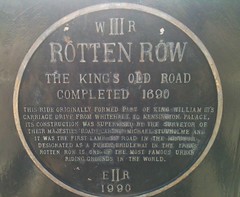
The Story
# William III and Rotten Row Standing here in Hyde Park, you're witnessing the remnants of an ambitious vision born from the practical needs of a Dutch king settling into his new English kingdom. Between 1690 and the early 1700s, William III ordered the carriage drive you're now walking along to be carved through these grounds, creating a safe and efficient route from his primary residence at Whitehall Palace to his preferred retreat at Kensington Palace—a journey he made frequently enough to justify this considerable engineering feat. What makes this particular stretch revolutionary isn't merely the road itself, but that it was lit by lanterns at night under the supervision of Captain Michael Studholme, making Rotten Row the first illuminated thoroughfare in all of Britain, a pioneering infrastructure that would transform how people moved through London after dark. This wasn't simply a royal convenience; it was William's practical gift to the kingdom, and when it was later opened to the public as a bridleway in the 1730s, the King's Old Road became the fashionable heart of London's riding culture—a legacy that has endured for over three centuries and remains one of the world's most celebrated equestrian paths.
Location
Hyde Park
Discover more stories across London