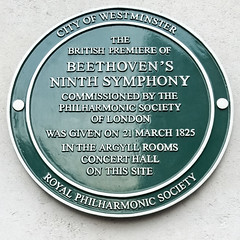
What did Green plaque № 13118 do at 252 Regent Street?

The Story
# The Site of Musical Revolution Standing at 252 Regent Street on that spring evening of 21 March 1825, London's musical elite gathered in the Argyll Rooms Concert Hall—a venue that no longer exists but whose legacy is immortalized in this very location—to witness something extraordinary: the British premiere of Beethoven's Ninth Symphony, that towering masterpiece featuring the "Ode to Joy" that would echo through centuries of culture. The Philharmonic Society of London had commissioned this performance, an act of artistic courage and vision that established their commitment to bringing the most ambitious contemporary works to British audiences at a moment when Beethoven himself was profoundly deaf and could never hear his own triumph. The Argyll Rooms, which occupied this Regent Street address, transformed itself for this single evening into the epicenter of European musical culture, a provincial but determined city finally claiming its place at the table of great musical capitals. For London and for classical music itself, this unassuming building on a bustling shopping street became the birthplace of one of humanity's greatest symphonic experiences on British soil—a moment of cultural awakening that still resonates today through the plaque marking the ground beneath your feet.
Location
252 Regent Street
Discover more stories across London