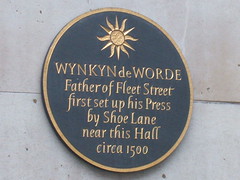
What did Wynkyn de Worde black plaque do at Stationers’ Hall Court?

The Story
# Wynkyn de Worde and Stationers' Hall Court Standing before this plaque near Shoe Lane, you're positioned at the birthplace of English printing's golden age—the spot where Wynkyn de Worde, inheriting William Caxton's revolutionary legacy, established his press around 1500 and transformed Fleet Street into the nation's publishing powerhouse. Here, in the shadow of what would become Stationers' Hall, de Worde didn't merely operate a printing business; he industrialized the dissemination of knowledge, producing over 800 printed works that ranged from devotional texts to practical guides, making books accessible to an expanding merchant class hungry for learning. This particular location, tucked near the bustling Shoe Lane with its proximity to the Thames for paper delivery and the commercial heart of medieval London, became the operational nerve center where de Worde proved that Caxton's vision could be scaled and sustained. What makes this address irreplaceable in de Worde's story is that it established the geography of English publishing itself—his choice to anchor his press here meant that for generations to come, Fleet Street would remain synonymous with the printed word, a legacy that echoed for over three centuries until the newspaper industry finally departed in the 1980s.
Location
Stationers’ Hall Court
Discover more stories across London