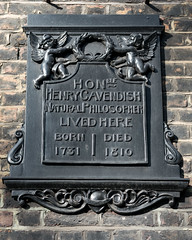
What did Henry Cavendish grey plaque do at 11 Bedford Square?

The Story
# Henry Cavendish at 11 Bedford Square Standing before this elegant Georgian townhouse in Bloomsbury's most refined square, you're looking at the private sanctuary where Henry Cavendish conducted some of the most meticulous scientific investigations of the late eighteenth century. For nearly four decades, from around 1770 until his death in 1810, Cavendish transformed the rooms of 11 Bedford Square into an extraordinary laboratory, where he performed experiments that would fundamentally reshape our understanding of chemistry and physics—including his revolutionary discovery of hydrogen as a distinct element and his elegant calculation of the Earth's density, achievements that required the kind of precision and undisturbed concentration that only a private, well-equipped home could provide. Behind these brick walls, away from the distractions of London's busier streets, the famously reclusive nobleman weighed, measured, and theorized in isolation, corresponding with fellow natural philosophers but rarely accepting visitors into his inner sanctum. This address represents not merely where Cavendish lived, but where he chose to live and work deliberately apart from society, creating a private world of rigorous scientific inquiry that would secure his legacy as one of Britain's greatest experimental minds.
Location
11 Bedford Square
Discover more stories across London