What did Labour Party black plaque do at Farringdon Street?

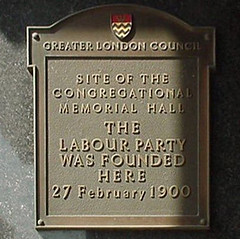
The Story
# Farringdon Street: Where British Labour Was Born Standing on Farringdon Street and gazing up at this modest plaque, you're positioned at the exact threshold where modern British politics pivoted on its axis. Within the Congregational Memorial Hall that once occupied this spot, fifty-nine determined men and women gathered on the grey afternoon of 27 February 1900 to formally establish the Labour Representation Committee—the organization that would evolve into the Labour Party and fundamentally reshape British democracy. This wasn't a grand ceremonial founding in Westminster, but rather an urgent, practical assembly of trade unionists, socialists, and cooperative activists who recognized that working people needed direct political representation, not merely patronage from Liberal politicians who took their votes for granted. The significance of this Farringdon Street address lies not just in what was decided here, but in what it represented: a historic moment when ordinary workers dared to imagine that they could build their own political power, and in doing so, created an institution that would eventually govern the nation and pioneer the modern welfare state.
Location
Farringdon Street
Discover more stories across London