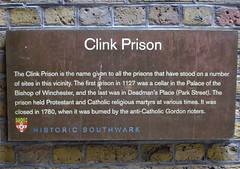
What did The Clink brown plaque do at Clink Prison Museum?
The Story
# The Clink's Enduring Legacy on Clink Street Standing on Clink Street today, you're walking across ground saturated with nearly seven centuries of human suffering and defiance—the very site where the Bishop of Winchester's palace once concealed a dungeon in 1127, transforming a cellar into one of England's most notorious prisons. The Clink earned its fearsome reputation not merely for its squalid conditions, but because its cells became a crucible for religious persecution, holding both Protestant and Catholic martyrs during the turbulent Reformation and Counter-Reformation, each faith taking turns as the hunted and the hunters. By the time the final Clink stood in Deadman's Place (now Park Street), it had become so symbolically tied to institutional oppression that the very word "clink" entered the language as slang for prison itself—a linguistic monument to its infamy. When anti-Catholic rioters torched the prison during the Gordon Riots of 1780, they didn't just burn a building; they destroyed the final chapter of a institution so embedded in London's collective memory that its name would outlive all the structures that bore it, making this stretch of Southwark forever hallowed ground for those seeking to understand how a single place can shape an entire nation's vocabulary of imprisonment.
Location
Clink Prison Museum, Soho Wharf, Clink Street
Discover more stories across London