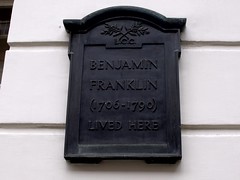
What did Benjamin Franklin black plaque do at 36 Craven Street?

The Story
# 36 Craven Street, Westminster Standing before this elegant Georgian townhouse just steps from the Thames, you're standing at the nerve center of Benjamin Franklin's most consequential years abroad—he called this address home for nearly eighteen years between 1757 and 1775, during his pivotal role as colonial representative for Pennsylvania and other American colonies. It was within these walls that Franklin conducted the diplomatic correspondence and political negotiations that would help shape the relationship between Britain and America during the crucial pre-Revolutionary period, while simultaneously pursuing his scientific experiments with electricity and atmospheric electricity that would cement his reputation across the Royal Society. The very stones of Craven Street witnessed Franklin's transformation from provincial printer to international statesman and natural philosopher, hosting some of London's most influential minds who gathered to debate both politics and science in his rooms. Though he would eventually return to Philadelphia as a revolutionary, it was here on this quiet Westminster street that Franklin learned to navigate the corridors of imperial power and first grasped the philosophical and political currents that would make him one of the Founding Fathers—making this unassuming address ground zero for the intellectual ferment that would ignite a nation.
Location
36 Craven Street, Westminster, WC2
Discover more stories across London