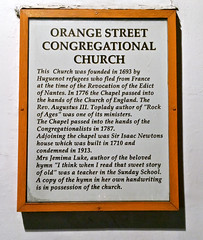
What did London white plaque Isaac Newton and Orange Street Congregational Church do at Orange Street?
The Story
# Isaac Newton's Orange Street Residence Standing on Orange Street, you're at the threshold of one of history's most remarkable intersections between scientific genius and spiritual community. Here, Sir Isaac Newton built his house in 1710—a sanctuary he created during the twilight of his life, after decades of revolutionizing our understanding of motion, gravity, and light from his Cambridge laboratory. Though Newton himself has long since departed these Georgian walls, his residence stood as a silent testament to a man who had fundamentally altered human knowledge, living quietly among a congregation of Huguenot refugees and later Congregationalists who sought their own form of refuge through faith. The tragedy of the church's later inscription—that Newton's house was condemned and demolished in 1913—reminds us that even the homes of the immortal are mortal; yet the plaque itself ensures that this ordinary street corner remains extraordinary, forever marking where one of humanity's greatest minds chose to spend his final years.
Location
Orange Street
Discover more stories across London