What did Christopher Wren and Robert Hooke stone plaque do at Fish Hill Street?
The Story
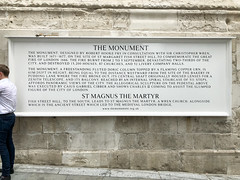
# The Monument's Genesis on Fish Hill Street Standing at Fish Hill Street where this plaque marks the ground, you're positioned at the exact epicenter where Robert Hooke and Christopher Wren's collaborative genius transformed tragedy into one of London's most iconic structures. After the Great Fire consumed this very neighborhood in September 1666—razing the medieval St Margaret Fish Street Hill that once occupied this spot—Hooke and Wren seized the opportunity to design The Monument, a revolutionary 202-foot Doric column that would rise here between 1671 and 1677 as both memorial and scientific instrument. This location wasn't arbitrary; by anchoring their monument at the site where the fire destroyed a beloved parish church, they created a powerful counterpoint—turning ash and loss into aspiration, with the column's height precisely mirroring the distance to where the fire began in Pudding Lane, making the monument itself a geographical compass of catastrophe. For Hooke especially, who served as the Royal Society's Curator of Experiments, The Monument represented the ultimate fusion of artistry, engineering, and empirical science, housing lenses for a zenith telescope within its shaft and offering those who climbed its 311 spiral steps an unprecedented panoramic understanding of London's rebuilt form—proving that from devastation, systematic rebuilding and intellectual innovation could create something that would endure for centuries.
Location
Fish Hill Street
Discover more stories across London