What did Anthony Trollope William Makepeace Thackeray do at Park Lane?
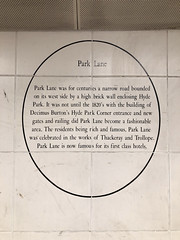
The Story
# Park Lane Standing before this plaque on Park Lane, you're witnessing the transformation that shaped the literary London of the Victorian era—a narrow, forgotten thoroughfare bounded by Hyde Park's imposing brick wall that suddenly burst into fashionable prominence when Decimus Burton's architectural genius redesigned Hyde Park Corner in the 1820s, complete with grand entrance gates and elegant railings that announced to London's elite that this was now the address for the wealthy and connected. It was precisely this newly minted prestige that captured the imaginations of Thackeray and Trollope, who, walking these very pavements among the grand townhouses of Park Lane's illustrious residents, found rich material for their novels—the concentrated world of privilege, social ambition, and aristocratic intrigue that their characters inhabited. Thackeray's sharp satirical eye and Trollope's keen observations of society's machinations found their perfect setting here, where real life mirrored fiction; the authors transformed Park Lane's glittering facades and the secrets behind them into some of Victorian literature's most cutting social commentary. Today, as the plaque notes, luxury hotels now occupy these addresses, but the street's significance endures as the very place where literature and life intersected, where Burton's architectural vision literally paved the way for the stories that would define an age.
Location
Park Lane
Discover more stories across London