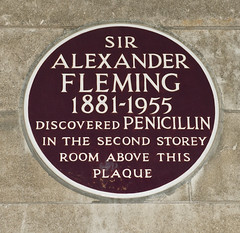
What did Alexander Fleming and penicillin maroon plaque do at St Mary's Hospital?
The Story
# St Mary's Hospital, Praed Street Standing before St Mary's Hospital on Praed Street, you're at the threshold of one of medicine's most consequential accidents. In September 1928, in a modest second-storey laboratory directly above where this plaque now hangs, Scottish bacteriologist Alexander Fleming returned from a summer holiday to find his culture plates contaminated—a mishap that might have frustrated any scientist, but Fleming's keen eye recognized something extraordinary in the clear halo surrounding the mold. This cramped, cluttered workspace, where Fleming had worked since 1906 and would continue until his death in 1955, became ground zero for the discovery of penicillin, the world's first widely used antibiotic that would ultimately save countless millions of lives. The significance of this particular room transcends mere laboratory space; it represents the moment when scientific curiosity, meticulous observation, and serendipity converged to revolutionize medicine, transforming St Mary's from a respected teaching hospital into a pilgrimage site for anyone seeking to understand how one person's attention to detail in one room changed the course of human history.
Location
St Mary's Hospital, Praed Street, W2
Discover more stories across London