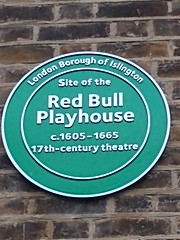
What did Red Bull Playhouse green plaque do at Hayward's Place?
The Story
# Red Bull Playhouse, Hayward's Place Standing on this narrow London street, you're standing at the threshold of one of Elizabethan and Jacobean England's most boisterous theatres, where for fifty years—from around 1605 until the Puritans shuttered the playhouses in 1655—audiences packed into the Red Bull to witness a raucous blend of comedies, tragedies, and spectacles that reflected the tastes of ordinary Londoners rather than court elites. This particular plot of ground hosted not the refined performances of the Globe or Blackfriars, but rather the raw, energetic productions that made the Red Bull notorious for its rowdy crowds, acrobatic actors, and sensational plots involving ghosts, witches, and daring sword fights. It was here that playwrights churned out plays designed for maximum theatrical impact—works like *The Shoemaker's Holiday* and adaptations of popular legends—establishing the Red Bull's reputation as the people's playhouse, where innovation in staging and staging spectacle often outpaced literary sophistication. The significance of this address lies not in quiet refinement, but in its role as a democratic cultural institution where working-class Londoners could escape their daily lives and experience theatre on their own terms, making Hayward's Place a vital crucible for a form of popular entertainment that would eventually help define English drama itself.
Location
Hayward's Place
Discover more stories across London