What did Charles II and Oliver Cromwell grey plaque do at Savoy Court?
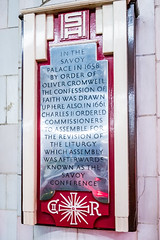
The Story
# Savoy Court: A Crossroads of Reformation and Restoration Standing at Savoy Court, you're positioned at one of the most ideologically contested spaces in seventeenth-century London—a palace that witnessed the religious convictions of two irreconcilable leaders separated by mere years and turbulent politics. In 1658, while Oliver Cromwell's Commonwealth still gripped the nation, commissioners gathered within these walls to compose the Confession of Faith, a document that crystallized the Puritan religious vision Cromwell had fought to establish during the Civil War. Barely three years later, after the Restoration brought Charles II to the throne, this same location transformed into a battleground of competing faiths when the king assembled his own commissioners here in 1661 for the Savoy Conference—an attempt to revise the Anglican liturgy and reconcile the Church of England with its Puritan critics. Though both events sought religious consensus through reasoned debate, the contrast is stark: one room had hosted Cromwell's uncompromising Puritan ideals, while the other hosted Charles's calculated efforts to restore monarchy and episcopal authority, making Savoy Court a physical embodiment of the religious and political rupture that defined an era.
Location
Savoy Court
Discover more stories across London