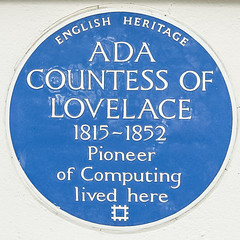
What did Ada Lovelace blue plaque do at 12 St James's Square?

The Story
# 12 St James's Square Standing before this elegant Georgian townhouse in one of London's most prestigious addresses, you're looking at the home where Ada Lovelace spent formative years of her intellectual development during the 1830s and 1840s—a period when she was intensively studying mathematics and beginning her correspondence with Charles Babbage about his revolutionary Analytical Engine. It was within these walls that she conducted her groundbreaking work translating Luigi Menabrea's paper on Babbage's machine, adding her own extensive notes that would eventually exceed the original text threefold, effectively creating the first computer algorithm in the process. The drawing rooms of St James's Square were where London's intellectual elite gathered, and Ada used this prestigious setting to establish herself as a serious mathematician and scientific thinker during an era when such pursuits were considered unladylike—hosting discussions with some of the greatest scientific minds of the Victorian age. This address, in the heart of Westminster's fashionable quarter, became the crucible where Ada transformed from a privileged noblewoman into a visionary pioneer whose work wouldn't be fully appreciated until the computer age itself arrived, more than a century after her death.
Location
12 St James's Square, Westminster, SW1
Discover more stories across London