What did London blue plaque St. Benet Sherehog do at Pancras Lane?
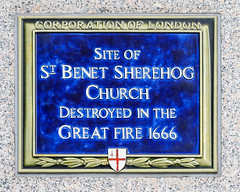
The Story
# St. Benet Sherehog, Pancras Lane Standing on Pancras Lane in the heart of the City of London, you're standing where one of medieval London's most distinctive parish churches once rose—a structure so tightly wedged between surrounding buildings that its unusual name derived from "Sherehog," meaning a sow or pig, possibly referencing its cramped, narrow profile squeezed among the City's dense streets. For nearly six centuries before the Great Fire of 1666, this church served as a spiritual anchor for the goldsmiths, merchants, and craftspeople of this bustling commercial district, its bell tower marking time and calling the faithful to worship through the medieval and Tudor periods. When the catastrophic fire swept through London in September 1666, St. Benet Sherehog was consumed entirely—one of eighty-seven churches lost in the inferno—leaving only memories and architectural plans in the City's records of what had once stood here. Though St. Paul's Cathedral rose from the ashes and some destroyed churches were rebuilt, St. Benet Sherehog's site was never restored to its former purpose, making this blue plaque on Pancras Lane a poignant reminder of a lost London that vanished in flames, taking with it centuries of daily worship and community life that once pulsed through these very stones.
Location
Pancras Lane, EC4
Discover more stories across London