What did Samuel Johnson and Hodge black plaque do at Gough Square?
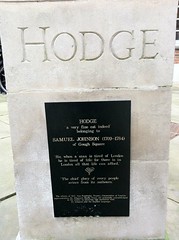
The Story
# Samuel Johnson and Hodge at Gough Square Standing before number 17 Gough Square, you are standing at the threshold of one of English literature's most industrious sanctuaries, where Samuel Johnson spent seventeen formative years (1746-1759) compiling the Dictionary of the English Language—a monumental task that would define the very words you read today. Within these walls, Johnson labored in a garret on the top floor, surrounded by books and papers, while his beloved black cat Hodge roamed the rooms, becoming the closest companion to a man whose wit and wisdom shaped the age; it was here that Johnson famously declared that "when a man is tired of London he is tired of life," a sentiment born from his deep roots in this very neighborhood. The Dictionary that emerged from this modest square revolutionized English scholarship and cemented Johnson's legacy as "the great Cham of literature," yet he remained modest about his labors, sharing his workspace generously with Hodge, whom he loved so dearly that he would personally purchase oysters for the cat when servants refused the task. This plaque commemorates not merely an address, but the beating heart of Johnson's creative genius—a place where lexicography, philosophy, and the simple companionship of a "very fine cat indeed" converged to produce one of history's greatest intellectual achievements.
Location
Gough Square
Discover more stories across London