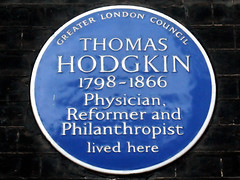
What did Thomas Hodgkin blue plaque do at 35 Bedford Square?

The Story
# 35 Bedford Square Standing before 35 Bedford Square, you're looking at the home where Thomas Hodgkin spent his most productive decades, transforming this Georgian townhouse into a hub of medical innovation and social conscience during the mid-nineteenth century. It was here, from his consulting rooms on the ground floor, that Hodgkin saw patients and conducted the clinical observations that would lead to his 1832 description of the lymphatic disease that would bear his name—Hodgkin's Lymphoma—one of medicine's most significant diagnostic breakthroughs. But this address represented far more than medical achievement; the upper floors hosted gatherings of London's reformist circles, where Hodgkin, a Quaker deeply troubled by social injustice, debated abolition, prison reform, and workers' rights with fellow physicians, philanthropists, and activists who shared his conviction that healing society required attending to both body and conscience. By living and working at this very spot in Bloomsbury's intellectual heart, Hodgkin created a rare Victorian synthesis—a place where rigorous medical science and radical social reform were not separate pursuits but interwoven aspects of a single commitment to human dignity.
Location
35 Bedford Square
Discover more stories across London