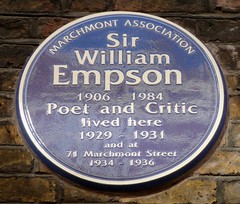
What did William Empson blue plaque do at 65 Marchmont Street?
.jpg?width=250)
The Story
# William Empson at 65 Marchmont Street During his formative years in the late 1920s and early 1930s, William Empson lived at this very address on Marchmont Street while establishing himself as one of the most innovative literary critics of his generation, having just published his groundbreaking work *Seven Types of Ambiguity* in 1930 at the remarkably young age of twenty-four. It was in these modest rooms that the young poet and theorist developed the analytical methods that would revolutionize how readers understood poetic language, particularly his concept of semantic density and the multiple layers of meaning embedded within a single word or phrase. The address represents a crucial moment in literary history when Empson was consolidating his ideas and beginning to attract the attention of the Cambridge intellectual circles and the broader literary world, transitioning from a brilliant student to an influential voice that would shape twentieth-century criticism. Standing before this plaque on Marchmont Street, you're witnessing the birthplace of a critical revolution—the lodgings where a young man's radical rethinking of how we read poetry took root and flourished, setting the stage for decades of influence on writers, scholars, and students who would follow his methods.
Location
65 Marchmont Street
Discover more stories across London