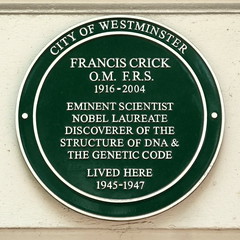
What did Francis Crick green plaque do at 56 St. George's Square?
The Story
# 56 St. George's Square Standing before this elegant Victorian townhouse in Pimlico, you're looking at the modest London home where Francis Crick embarked on the intellectual journey that would transform biology forever. From 1945 to 1947, while working at the Medical Research Council's Crystallography Unit at King's College, Crick lived at this address during the formative years when he was still transitioning from physics to biology, absorbing the revolutionary ideas about molecular structure that would soon captivate him. Though the actual breakthrough work with Watson and Wilkins wouldn't come until later at Cambridge, it was in homes like this one—nestled in the quieter squares of central London—that Crick lived as an ambitious young scientist, grappling with the fundamental questions about life's organization that would culminate in the 1953 model of DNA's double helix. This plaque marks not the place of discovery itself, but something equally vital: the moment when a brilliant mind was poised on the threshold of reshaping human understanding, living an ordinary London life while harbouring the intellectual spark that would illuminate one of science's greatest secrets.
Location
56 St. George's Square
Discover more stories across London