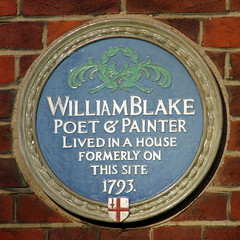
What did William Blake blue plaque do at Hercules Road?
.jpg?width=250)
The Story
# Hercules Road Standing before this modest plaque on Hercules Road, you're marking the threshold of one of William Blake's most prolific and turbulent periods—the house that stood here became his refuge and workshop in 1793, just as revolutionary fervor gripped Europe and England grew suspicious of radical thought. It was within these walls that Blake created some of his most visionary illuminated books, including plates from *Songs of Innocence and Experience*, while his wife Catherine worked alongside him in the painstaking process of etching and hand-coloring each page by candlelight. The address itself held peculiar significance for Blake, who believed deeply in the spiritual dimensions of place; he would later claim to have experienced visions here, conversations with biblical figures that he translated directly into his artistic output. Though the original house has long vanished from this South London street, the blue plaque remains a quiet testament to the fact that from this now-vanished room, one of England's greatest artistic visionaries was quietly producing work that would not be fully appreciated for another century—proving that genius often labors in obscurity, leaving only a marker to tell us where the magic once occurred.
Location
Hercules Road
Discover more stories across London