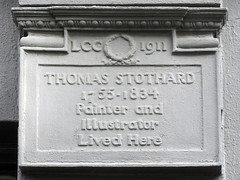
What did Thomas Stothard black plaque do at 28 Newman Street?

The Story
# 28 Newman Street Standing before this elegant Georgian townhouse in the heart of Westminster, you're looking at the studio and home where Thomas Stothard spent the most productive decades of his career, transforming from a promising young artist into one of England's most celebrated illustrators. It was within these walls, between 1776 and his death in 1834, that Stothard created the delicate pen-and-ink illustrations that would grace the pages of countless literary classics—his work adorning editions of Don Quixote, The Odyssey, and Chaucer—while simultaneously maintaining his reputation as a painter of romantic and literary scenes. The address became something of a creative factory, where patrons and fellow artists would visit to commission work or view his latest designs, making Newman Street itself a hub of artistic activity during the late Georgian and Romantic periods. What makes 28 Newman Street truly significant is that it represents the physical anchor of Stothard's influence on British visual culture: here, in this modest townhouse, he proved that illustration was as worthy of artistic genius as fine art itself, ultimately shaping how generations of readers experienced the great works of literature through his refined, imaginative vision.
Location
28 Newman Street, Westminster, W1
Discover more stories across London