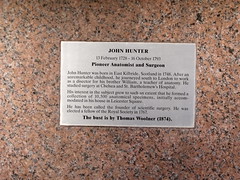
What did John Hunter brass plaque do at John Hunter bust?
The Story
# John Hunter's Leicester Square Standing beneath this brass plaque in the heart of Leicester Square, you're positioned at the very nucleus of John Hunter's revolutionary work—the house where he accumulated his staggering collection of 10,500 anatomical specimens, transforming a private London residence into what amounted to a shrine to human anatomy. During the latter decades of the 18th century, this address became the beating heart of his anatomical empire, where he meticulously catalogued, preserved, and studied the intricate structures of the human body with an obsessive precision that would fundamentally reshape surgical practice. Visitors to his Leicester Square home would have witnessed specimens crowded into every available space—bones articulated in glass cases, organs suspended in preservative solutions, pathological preparations documenting disease and deformity—creating an environment that was part laboratory, part museum, and entirely devoted to unlocking the secrets of human structure. It was here, amid the peculiar smell of preservation and the tangible evidence of mortality surrounding him, that John Hunter developed the empirical, evidence-based approach that earned him the title "founder of scientific surgery," making this modest London address one of the most consequential medical workspaces in British history.
Location
John Hunter bust, Leicester Square
Discover more stories across London