What did Isaac Newton brass plaque do at Newton bust?
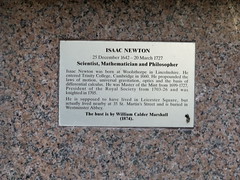
The Story
# Isaac Newton and Leicester Square Standing before this bronze bust in the heart of Leicester Square, you're at the epicenter of London's scientific enlightenment, though the truth is delightfully more complicated than the plaque suggests—Newton never actually lived here, but the square became so synonymous with his legacy that this memorial claims the space anyway. During his most productive decades in London, particularly after his appointment as Master of the Mint in 1699, Newton conducted his affairs from the nearby townhouse at 35 St. Martin's Street, just a stone's throw away, making this elegant square the neighborhood of his mature genius when he was reshaping the Royal Society and cementing his revolutionary theories about motion, gravity, and light. What makes Leicester Square significant is not what happened within its confines, but rather what it represents: a London that had transformed into a capital of intellectual inquiry, where a man like Newton could live modestly in its vicinity while fundamentally altering humanity's understanding of the physical universe. Today, this bust—sculpted nearly 150 years after his death—serves as a public acknowledgment that this corner of London was hallowed ground for the scientific mind, a place where one of history's greatest intellects walked these very streets, and where we, nearly three centuries later, pause to contemplate the magnitude of his achievement.
Location
Newton bust, Leicester Square
Discover more stories across London