What did Hubert Le Sueur Charles I do at King Charles I statue?
The Story
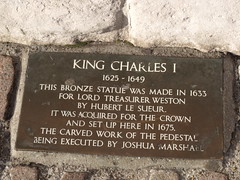
# The Statue at Charing Cross Standing at this very intersection where the medieval Eleanor Cross once marked the City's western boundary, you're witnessing the culmination of a remarkable artistic journey that began decades earlier in Lord Treasurer Weston's private commission. When Hubert Le Sueur, the King's master sculptor, cast this bronze in 1633, he created not merely a portrait but a calculated statement of royal authority—one so politically charged that it survived the Civil War and Interregnum only to be strategically re-erected here in 1675, after the Restoration, as a symbol of monarchical power reclaimed. Joshua Marshall's carved pedestal, executed with the precision of one of England's finest masons, anchored Le Sueur's sculpture at Charing Cross specifically because this bustling junction was where Londoners gathered, where proclamations were read, and where the Crown's presence could be felt by the greatest number of subjects. The plaque you're reading today marks the spot where artistic ambition, political survival, and royal symbolism converged—a bronze figure that has watched over one of London's most vital crossroads for nearly 350 years, silently testifying to the turbulent reign it immortalizes.
Location
King Charles I statue, Charing Cross near Trafalgar Square
Discover more stories across London