The Amy Winehouse statue stands on a plinth at Stables Market in Camden, a short walk from the Roundhouse and a half mile from the flat where she spent the last three years of her life. It was unveiled on 14 September 2014, on what would have been her 31st birthday, and it is the only life-sized bronze of the singer anywhere in the world. Ten years later, on 14 September 2024, what would have been her 41st birthday, English Heritage unveiled a blue plaque in her memory at 30 Camden Square, the house where she lived from 2008 until her death in July 2011. The two landmarks, statue and plaque, bookend a ten-year arc of public commemoration inside the same NW1 postcode.
This guide walks both in the right order, plus every other Amy Winehouse landmark in Camden that a visitor can actually reach on foot in an afternoon: her first Camden flat, the pub she called her local, the market stall she used to buy vintage from, the Jazz After Dark that closed on the night she died, and the Roundhouse stage where she played her last London gig. It is a pilgrimage guide written with respect and with the same level of architectural detail we bring to every blue plaque we cover. For the full context on how English Heritage chooses its plaque subjects, see our complete guide to London blue plaques.
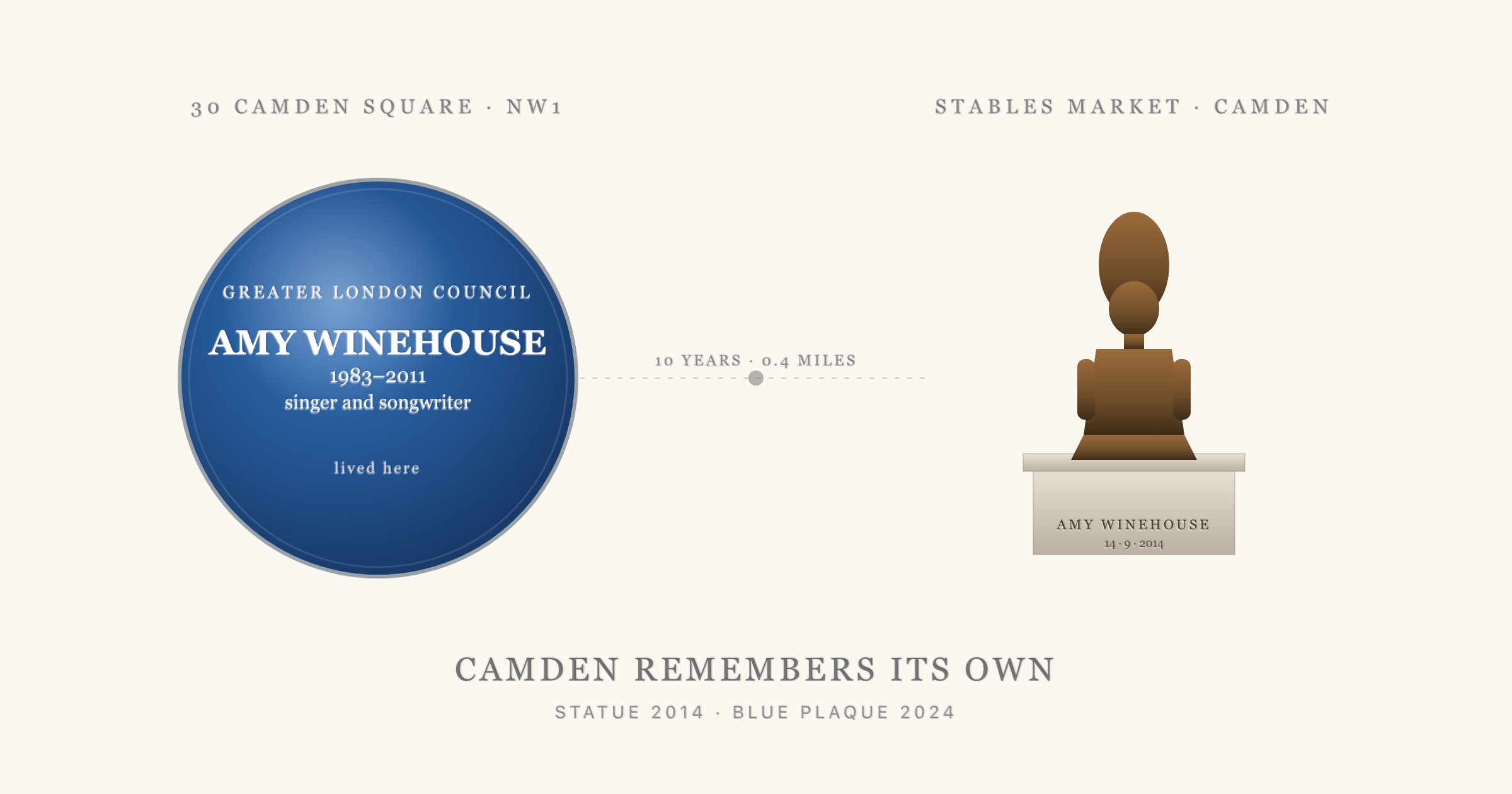
The Amy Winehouse Statue at Stables Market
The statue is at the north end of Stables Market, Camden, on the ground floor of the converted Victorian horse hospital that now houses a warren of independent retail units. Coming in from Chalk Farm Road or down from the Roundhouse side, follow signage for the Horse Hospital and the statue sits in a small paved courtyard near the centre of the complex. There is no charge to visit and the courtyard is open during market hours, broadly 10am to late most days.
What the Statue Actually Shows
The sculpture is by Scott Eaton, a British-American sculptor who had worked in digital effects for the film industry before specialising in figurative bronzes. The commission came from Amy Winehouse's father, Mitch Winehouse, who wanted a work that showed his daughter at the height of her powers and at an age she would have recognised as her own. Eaton worked from photographs and film footage, and the family's brief was specific: beehive hair, dark eyeliner, ballet flats, the Daddy's Girl belt, and an expression that is considered rather than performative.
The figure stands roughly five foot five, the singer's actual height, on a stone plinth that brings the top of the beehive to around seven feet. Arms are folded, hip cocked, head tilted down and to the side in what one journalist described as "looking at the back row." A small Star of David pendant around her neck, which Amy wore through her adult life and which the sculptor chose to keep in the bronze, is visible from the front.
On the plinth are a short inscription and her dates:
Amy Winehouse 14 September 1983 – 23 July 2011
And below the dates, in smaller lettering, the family chose one of her own lines:
A girl and her saxophone
The reference is to Amy's teenage years at the Sylvia Young Theatre School and her early devotion to jazz, before pop-industry attention rewrote the story around her.
Why It Is Here and Not in Southgate
Amy Winehouse was born in Southgate, north London, and grew up in Whetstone. Her Camden years were the adult chapter, from about 2004, when she started frequenting the Hawley Arms in her early twenties, until her death in 2011. The family and the Camden Business Improvement District chose Stables Market specifically because it was the Camden she chose for herself. Southgate has her early life; Camden has the woman she became, and the community that still claims her.
The English Heritage Blue Plaque at 30 Camden Square
Half a mile east of the statue, across the Camden Road bridge and past the roundabout at the southern end of Camden Square, the blue plaque sits on the front of 30 Camden Square, a three-storey terraced house on the south-west corner of the square's garden.
What the Plaque Says
The plaque is a standard English Heritage ceramic blue roundel, installed at first-floor height. The inscription reads:
Amy Winehouse 1983-2011 singer and songwriter lived here 2008-2011
The phrasing follows English Heritage's long-running convention. "Singer and songwriter" is the same dry register the organisation used for Freddie Mercury eight years earlier. Dates are her lifespan, then her residency at the address. The word "lived here" is the standard verb; English Heritage uses "died here" only rarely, and only where the death is itself the historical event the plaque commemorates. The committee decided against it here.
The Criteria, the Twenty-Year Rule, and the 2024 Unveiling
English Heritage blue plaques operate under two well-known constraints. The subject must have been dead for at least twenty years (or have passed the centenary of their birth), and the plaque must be installed on a building where the subject demonstrably lived or worked, in recognisable form, not a replacement or reconstruction.
The twenty-year rule is the reason the Amy Winehouse plaque could not be installed before 2031, which raised an obvious question. The answer, in the announcement, was the plaque was an exception, granted under a clause the committee invokes rarely, where the subject's cultural significance and the public demand for commemoration combine to justify moving earlier than the default interval. The last comparable exception was Lennon's in 2010 (dead since 1980, the interval was 30 years, well inside the normal window), and before that Diana, Princess of Wales. Amy Winehouse's plaque at thirteen years was, at the time of its unveiling, the shortest gap between death and plaque in the scheme's history.
The unveiling on 14 September 2024 was attended by Mitch and Janis Winehouse, the Amy Winehouse Foundation, and several hundred members of the public who gathered in Camden Square from early morning. Recordings of the ceremony show the garden square filled in every direction, Camden-standard flowers and candles on the front steps of number 30, and one of the sound engineers from her final studio sessions in the front row.
Why Number 30 and Not One of Her Earlier Flats
Amy Winehouse lived at several Camden addresses between 2004 and 2011. Her first flat, on Jeffrey's Place off Camden Road, is where she lived while recording Back to Black. Later she was briefly at Prowse Place, then at a Bryanston Square flat in Marylebone (outside NW1), before buying the house at 30 Camden Square in 2008 with the royalties from the album.
English Heritage's house-specific rule points the plaque at the residence where the subject lived longest or where the most significant work was produced. The Camden Square house satisfies both. It was her home for the final three years of her life, and although Back to Black itself was recorded before she moved in, the late-career material (including the unfinished tracks later released on Lioness: Hidden Treasures in 2011) was written there.
The Camden Amy Winehouse Walking Tour
The statue and the plaque are half a mile apart, and between them lie most of the landmarks that mattered in her Camden life. The route below is walkable in about an hour at a reflective pace, longer if you stop to read the plaques along the way.
Stop 1 · The Statue at Stables Market
Start at the bronze. Ten minutes is enough. The courtyard is not large and the statue is a single vantage. Read the inscription, note the Star of David detail, step back for the wider framing. The surrounding market stalls sell a mix of vintage clothing, records, and street food, which is approximately what the market sold when Amy was a regular.
Stop 2 · The Hawley Arms
Walk out of Stables Market onto Chalk Farm Road, south toward Camden Town tube. Turn left onto Castlehaven Road; the Hawley Arms is on the corner at number 2. It was Amy's local. The pub burned to the ground in the 2008 Camden Market fire (the same fire that gutted half of Stables Market), was rebuilt on the original footprint, and reopened in 2009. The upstairs room is named in her honour and the walls carry a few framed pieces of memorabilia. It is still a working pub, not a shrine; go for a drink rather than a pilgrimage.
Stop 3 · The Good Mixer
A three-minute walk across Camden High Street to Inverness Street. The Good Mixer was a Britpop institution in the 1990s (Blur and Oasis famously crossed paths in its back room) and in the mid-2000s became a second local for Amy. It is smaller, scruffier, and less memorialised than the Hawley. It is also, for that reason, the pub she is said to have preferred on off-nights.
Stop 4 · Jeffrey's Place (First Flat)
Back east across Camden High Street, onto Camden Road, then left onto Jeffrey's Street; Jeffrey's Place is a short mews that branches north. Amy's first Camden flat was here from 2004 to 2006, during the writing and recording of Back to Black. The flat is private residential and not marked; the mews itself is worth the detour for the quiet contrast to Camden High Street forty yards away.
Stop 5 · Camden Square and the Blue Plaque at Number 30
Continue east on Camden Road, cross Agar Grove, and turn left into Camden Square. Number 30 is on the south-west corner of the garden square. The plaque is above the front door, visible from the pavement. The square itself is a quieter residential set-piece of London late-Victorian terraces around a private garden. Do not ring the bell; the house is a private residence and the current owners are not guides.
Stop 6 · The Roundhouse
From Camden Square, a ten-minute walk back west via Agar Grove brings you to Chalk Farm Road and the Roundhouse. Amy played the Roundhouse multiple times across her career; her final London gig was a short set on the iTunes Festival stage there in 2008. The venue is still the best mid-sized concert hall in north London, and the iron-roofed Victorian engine shed has been a performance space continuously since 1966.
Stop 7 · Optional · Jazz After Dark, Soho
If you have energy for a tube ride south to Soho, Jazz After Dark on Greek Street was Amy's adopted jazz club in central London. She played unannounced there many times, and the club closed briefly in 2011 on the week of her death. It has since reopened under different management. It is the furthest stop from Camden and the least essential; for the Camden-focused tour, end at the Roundhouse.
Every one of these stops pairs usefully with the broader Camden-centred history we cover in our alternative walking tour of London, which threads the blue plaques of the neighbourhood into a wider afternoon.
Why Amy Winehouse Mattered, in Architectural Terms
Blue plaques are not fan shrines; they are London's oldest commemorative scheme, administered under a strict set of rules that prize historical significance over popularity. The case made to English Heritage for Amy Winehouse's plaque rested on three specific arguments:
- The Back to Black album. Released in 2006, it was the best-selling album in the UK of the 2000s (later overtaken, then reclaimed), reintroduced a six-decade-old Motown and girl-group sound to a mainstream twenty-first century audience, and has stayed continuously in the UK top 100 for over a decade. By album-as-artefact terms, it is comparable in longevity to Fleetwood Mac's Rumours or Pink Floyd's Dark Side of the Moon.
- Vocal influence on a generation. Adele, Sam Smith, Dua Lipa, and Raye have all cited Amy as a direct technical influence. Her phrasing (jazz-inflected, behind the beat, using vibrato as punctuation) became a template other singers studied explicitly.
- Cultural impact beyond music. The Amy Winehouse Foundation, run by her parents, has operated continuously since 2011 and supports young people dealing with addiction and mental-health challenges. The foundation's work, rather than Amy's personal struggle, is what English Heritage cited in the announcement.
These are the kind of arguments that cross from "popular" into "historically significant," which is the bar the plaque committee applies.
Visiting: Practical Notes
A few specifics that trip up first-time visitors:
- The statue is inside Stables Market, which has multiple entrances. The main Chalk Farm Road entrance is the shortest walk. Opening hours track the market's broader pattern; most days 10am to around 7pm, later on weekends.
- The blue plaque is on a private residence. Camden Square is a genuine residential street; the family who live at number 30 are not connected to Amy Winehouse. Photograph the plaque from the pavement, do not ring the bell, and do not leave offerings on the front steps (Camden council clears them weekly and the family has asked for restraint).
- Tube: Camden Town (Northern line) is the closest station to the statue. Caledonian Road (Piccadilly line) or a longer walk from Camden Town is the closest to the plaque.
- Good days to visit: weekday afternoons avoid the market crush. The anniversary of her death (23 July) and her birthday (14 September) both draw larger crowds to both sites.
If you want the broader context for how Camden accumulated this density of musical plaques (Amy, the Roundhouse, the Dublin Castle, the Hawley), our alternative walking tour of London stitches Camden's musical heritage into a wider route through the borough. And if musicians-with-London-plaques is your interest, the Freddie Mercury blue plaque guide covers the other great British singer whose plaque went up in the same decade.
Amy Winehouse's Camden is a small geography with a dense biography. The statue and the plaque are the two public points on that geography. Between them, the pubs, the markets, the mews flats, and the Roundhouse stage round out a tour that is neither a tabloid retrospective nor a simple grief walk. It is, more than anything, a short circuit through a neighbourhood that still considers her one of its own.